VERTEX | Geometry of Edges: Osi Audu, Ginnie Gardiner, Whitney Hagen, Alex Kveton, Susanna Ronner, Lynne Tobin & Kati Vilim

In Vertex, the artists independently create a balancing act between the physical and the perceived as colors create the depth and movement animating the paintings and sculptures together with the surrounding space.
(Saugerties, NY)- Vertex | Geometry of Edges opens with a reception for the artists on Sunday, June 28, 2:00 - 4:00, and runs through Sunday 2 August, 2026, at the Richards Gallery at Opus 40. Tickets can be purchased at the Opus 40 website.
ABOUT THE EXHIBITION
In geometry, a vertex is the meeting place of edges and the origin of the third dimension. The optical illusion created by this junction convinces the viewer that what they see in fact, exists. Because of this three-dimensional illusion, the paintings of Ginnie Gardiner, Whitney Hagen, Susanna Ronner, Lynne Tobin, and Kati Vilim fool the eye with color, form, and line, presenting a believable space that defies the flat surface on which they are painted. The sculptors, Osi Audu and Alex Kveton, contend with solid shapes and forms. Their art directly and deliberately challenges the intangible, and their forms engage the invisible spaces carved out by their work. It is in the edges of these compelling artworks, the vertices where these painted and sculpted edges meet, that the visual effects of space begin.
Osi Audu: Not content with the painted surface, Osi Audu constructs disciplined forms from metal that alternate between wiry lines and shaped planes according to the viewer's position.
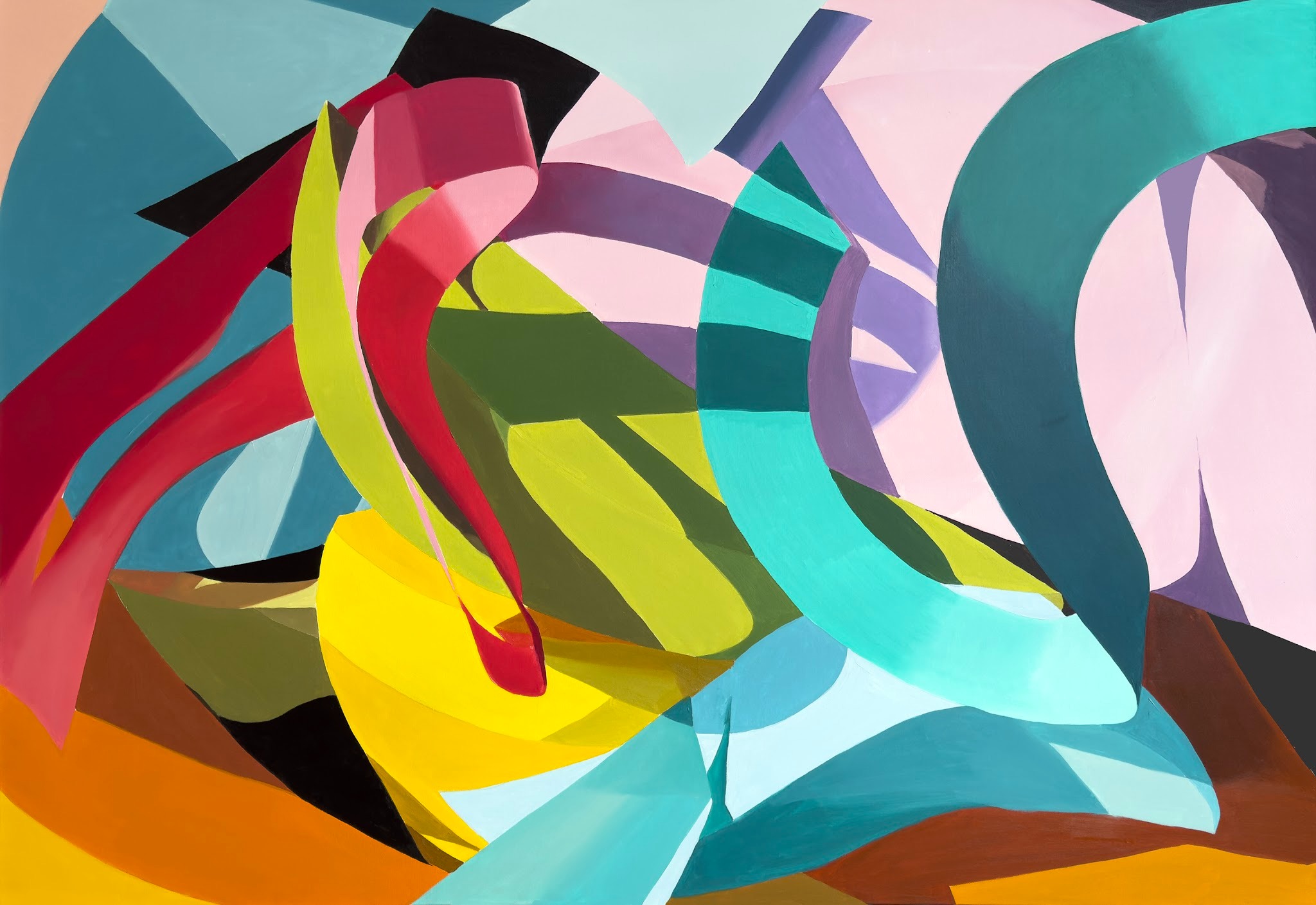
Ginnie Gardiner: Gardiner meticulously creates abstract collages from paper and color acetate, which the artist then precisely paints on canvas, exploring the subtle color interactions between light and the form's edge.
Whitney Hagen: Whitney Hagen’s paintings depend on flat colors to shape and bend space. Her use of uniformly applied pigments depicts an alternate universe independent of tonal gradations.
Alex Kveton: The crisp mineral edges of Alex Kveton's sculptures defy their metallic structure with organic, sinuous movement.
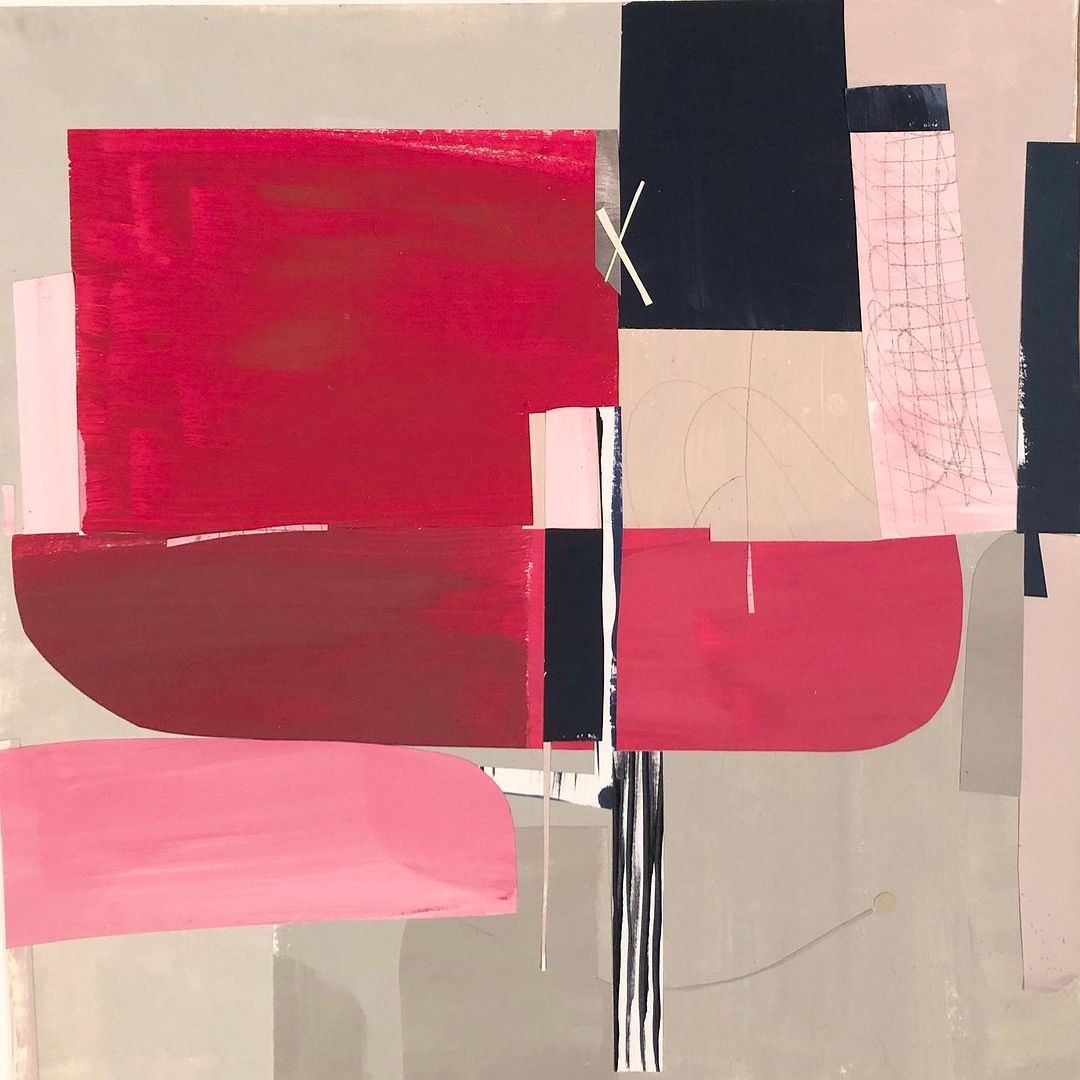
Susanna Ronner: Susanna Ronner's vibrating lines dance around and among colored shapes in an improvised game between mass and movement.
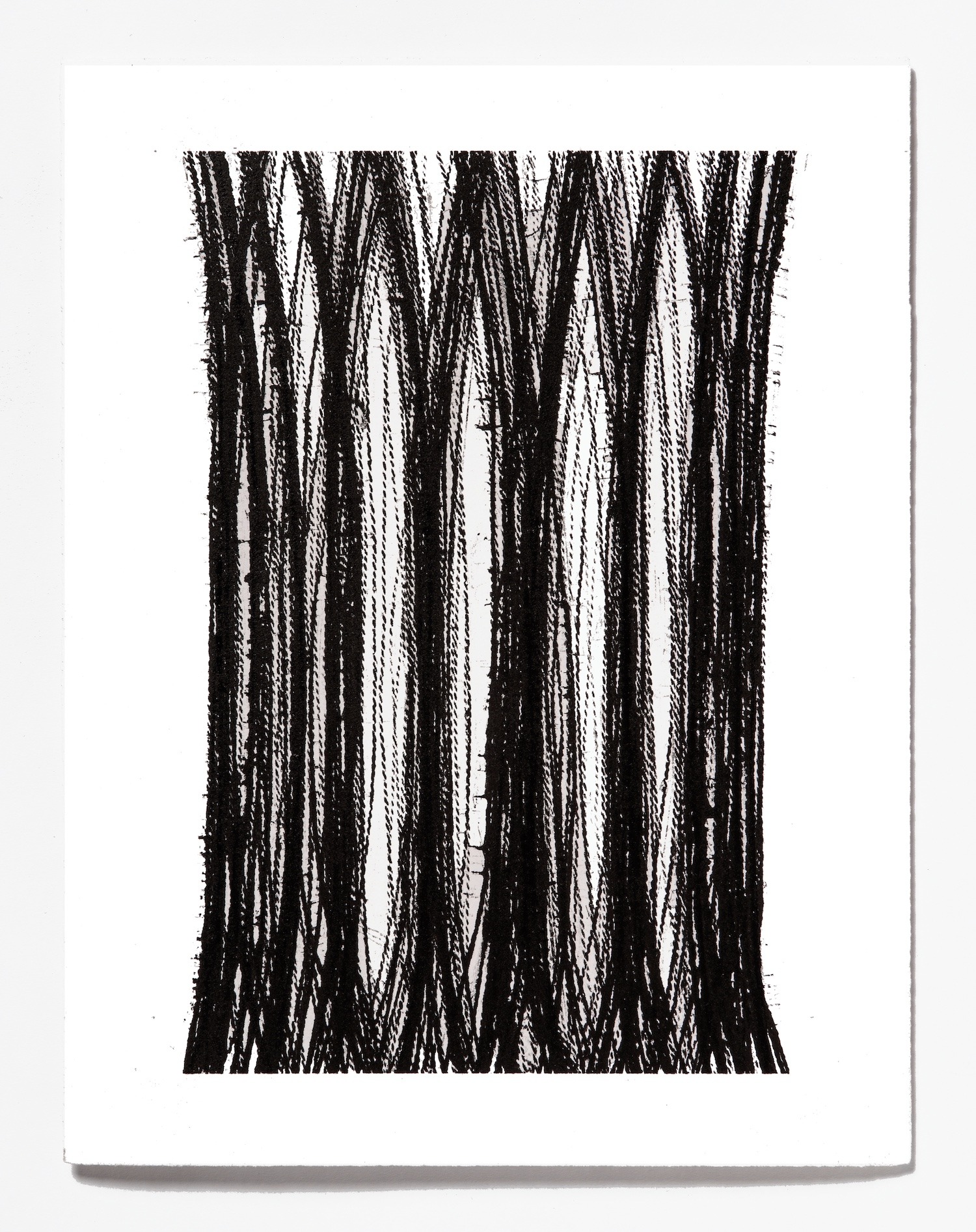
Lynne Tobin: Lynne Tobin references a space beyond the confines of paper as arcs emerge from rhythmic lines drawn with ink-soaked string.
Kati Vilim: The prismatic paintings of Kati Vilim depend on the illusion of refraction as light changes through its passage from one angled edge to another.
In Vertex, the artists independently create a balancing act between the physical and the perceived. The oscillating space created by the shifting planes in these artworks finds its equilibrium only at the painted edge or the welded joint. Like the intricate vertices of paper origami, each artist folds space, and from this intricate work, a new dimension emerges.
-

Osi Audu
Self Portrait with a Yoruba Hairstyle, 2021
painted, welded steel
19 1/2 x 11 1/2 x 10 1/2 in | 48.3 x 27.9 x 25.4 cm
-
Kati Vilim, Service Requested, 24" x 24 in
-
Ginnie Gardiner, Insterspace 167, 2026, oil on linen, 28 x 44 in
-
Whitney Hagen
Glass Hillside, 2025
acrylic on wood, 12 x 12 in
-
Whitney Hagen
PushPull, 2025
acrylics on board
8 x 8 in
-
Whitney Hagen
Circumvent, 2024
acrylics on board, 12 x 12 in
-
Alex Kveton
Tropic Fire
Bronze, 43" x 10"
-
Susanna Ronner
Quadrato #1, 2025
collage, 11.5 x 12. in
-
Susanna Ronner
Quadrato #17, 2026
collage on paper, 11.5x12 _ framed 19.20.5.jpeg
-
Lynne Tobin
Pillar II, 2020
Ink Paper, 15 x 11 5 in
-
Lynne Tobin
Pillar Series
-
Kati Vilim, New Time Zone, 18 x 18 in


-

At Upstate Art Weekend, Cars and Barns Are Galleries
During the seventh annual event, hundreds of artists proved that art has never been confined to “white cube” galleries.Taliesin Thomas, Hyperallergic, June 29, 2026 -

At Upstate Art Weekend, Cars and Barns Are Galleries
During the seventh annual event, hundreds of artists proved that art has never been confined to “white cube” galleries.Taliesin Thomas, Hyperallergic, June 29, 2026

VERTEX | Geometry of Edges
Opus 40 · The Richards Gallery
356 George Sickle Road · Saugerties, NY 12477
26 June - 2 August
OPENING RECEPTION 28 June, 2:00 - 4:00 PM
Gallery Hours:
June - July | Friday - Sunday: 10:00 - 5:00 PM
TICKETS | EXHIBITION WEBPAGE
(Saugerties, NY) -
In geometry, a vertex is the meeting place of edges and the origin of the third dimension. The optical illusion created by this junction convinces the viewer that what they see really exists. Because of this three-dimensional illusion, the paintings by Ginnie Gardiner, Whitney Hagen, Susanna Ronner, Lynne Tobin, and Kati Vilim are intrinsically deceptive. The arrangement of color, form, and line presents a believable reality that is defied by the flat surface on which it is painted, fooling the viewer! The sculptors, Osi Audu and Alex Kveton, contend with solid shapes and forms. Their art directly and deliberately challenges the intangible and their forms engage the invisible spaces carved out by their work.
It is in the edges of these compelling artworks, the vertices where these painted and sculpted edges meet, that the visual effects of space begin.
Osi Audu: Not content with the painted surface, Osi Audu constructs disciplined forms from metal that alternate between wiry lines and shaped planes according to the viewer's position.
Ginnie Gardiner: Ginnie Gardiner meticulously creates abstract collages from paper and color acetate, which the artist then precisely paints on canvas, exploring the subtle color interactions between light and the form's edge.
Whitney Hagen: Whitney Hagen’s paintings depend on flat color planes to shape and bend space. Her use of uniformly applied pigments depicts an alternate universe independent of tonal gradations.
Alex Kveton: The crisp stainless-steel edges of Alex Kveton's sculptures defy their metallic structure with organic, sinuous movement.
Susanna Ronner: Susanna Ronner's vibrating lines dance around and among colored shapes in an improvised game between mass and movement.
Lynne Tobin: Lynne Tobin references a space beyond the confines of paper as arcs emerge from rhythmic lines drawn with ink-soaked string.
Kati Vilim: The prismatic paintings of Kati Vilim depend on the illusion of refraction as light changes through its passage from one angled edge to another.
In Vertex, the artists independently create a balancing act between the physical and the perceived. The ever-shifting planes in these artworks finds their equilibrium only at the painted edge or the welded joint. Like the intricate vertices of paper origami, each artist folds space, and from this intricate work, a new dimension emerges.
|
|
|
|
Osi Audu, Self-Portrait w/a Yoruba Hairsyle |
Ginnie Gardiner, Insterspace 167, 2026,, |

|
|
|
|
Whitney Hagen, Push Pull, 2025 |
Alex Kveton |

|
|
|
|
Susanna Ronner, Quadrato #1 |
Lynne Tobin, Pillar No.2 |
|
|
|
|
Kati Vilim, Service Requested |

ABOUT OPUS 40
|
|
|
Opus 40 | 356 George Sickle Road, Saugerties, NY 12477 |

ABOUT OPUS 40
Created over four decades by visionary artist and Bard professor Harvey Fite, Opus 40 is a 6.5-acre earthwork made of finely fitted bluestone, rising out of an abandoned quarry at the foot of Overlook Mountain in Saugerties, NY. In 1978, Fite’s widow, Barbara, established the nonprofit Opus 40 Inc, opening the sculpture, along with 63 acres of meadows, walking trails, bluestone quarries, as well as the Quarryman's Museum to visitors from all over the world. Today, Opus 40 offers a diverse selection of events in a wholly unique setting that Architectural Digest has called “one of the most beguiling works of art on the entire continent.”
###


